 Kaltreo Power
Service guide · Published August 2026
Diesel Fuel Filter Replacement Interval
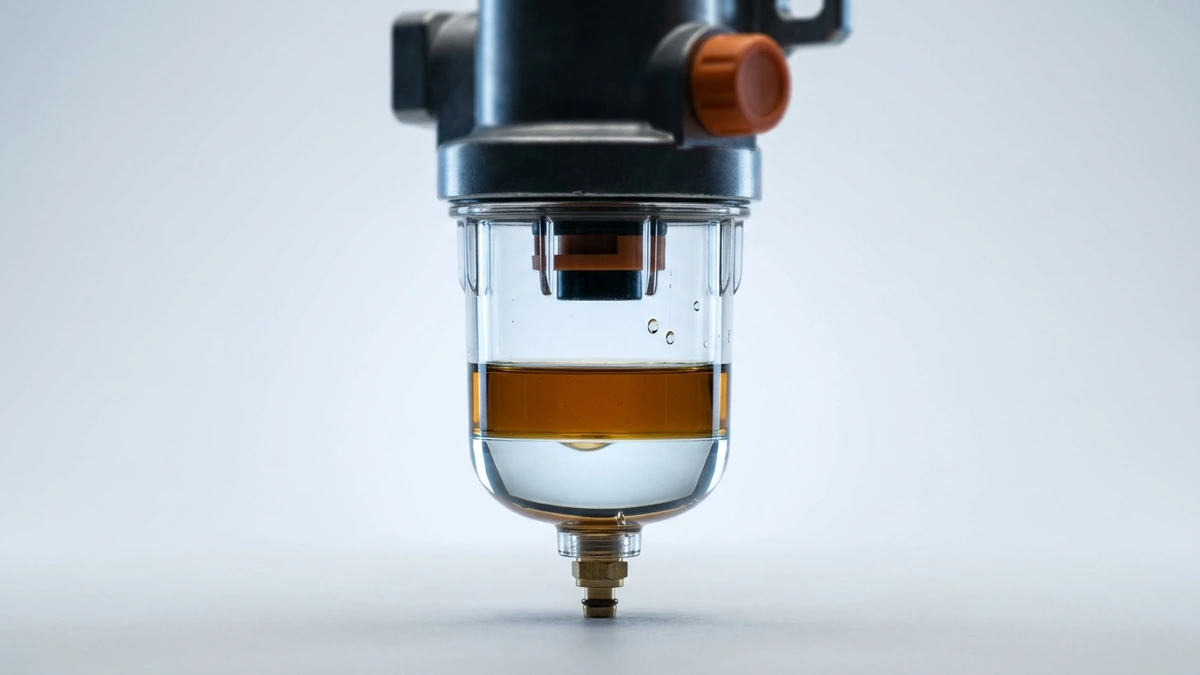
Quick answer: On-highway, Cummins specifies 25,000–75,000 miles for the X15 by fuel-economy band. Off-highway, Caterpillar specifies every 1,000 service hours for prime power and annually for standby. Those two schedules are not convertible into each other, and no universal figure exists. Separately from the replacement interval, drain the water separator daily — water, not particulate, is what destroys modern injection systems.
Why there is no universal interval
Fuel filter advice is usually quoted as a single number with no engine attached. That number cannot exist, because the two families of diesel engine measure service in incompatible units. On-highway engines count miles, banded by fuel economy as a proxy for load. Stationary and off-highway engines count running hours, or fall back to the calendar when they run rarely.
The same reasoning governs the oil filter change interval, and for the same reason: duty cycle, not the part, sets the schedule.
On-highway intervals
Cummins Bulletin 5410641, covering EPA 2017 X15 hardware, ties the fuel filter to the same duty bands as the oil drain:
| Duty cycle | Fuel filter (EPA 2017) | Fuel filter (2021 hardware) |
|---|---|---|
| Severe | 25,000 miles | 25,000 miles |
| Short-haul | — | 50,000 miles |
| Normal | 35,000 miles | 60,000 miles |
| Light | 50,000 miles | 75,000 miles |
The right-hand column comes from Bulletin 6504123 for 2021 X15 Performance hardware, and the gap matters if you run a mixed-age fleet: normal duty moves from 35,000 to 60,000 miles on the same engine family. Servicing both generations to one schedule means either doing needless work on the newer trucks or overrunning the older ones. Cummins also lists up to 100,000 miles when the FF5971NN filter is fitted — an extended interval bought with hardware, not with optimism.
Off-highway and standby intervals
Caterpillar's Operation & Maintenance Manual SEBU7148-09 for the 3508B–3516B generator sets splits the fuel system into a primary filter, which is cleaned, inspected or replaced, and a secondary filter, which is replaced:
| Task | Prime power | Standby |
|---|---|---|
| Primary filter — clean / inspect / replace | Every 1,000 service hours | Every year |
| Secondary filter — replace | Every 1,000 service hours | Every year |
| Fuel tank water and sediment — drain | Daily | Every week |
| Fuel filter differential pressure — check | Daily | Every week |
Note what is daily and what is annual. The filter is a yearly item on a standby set. The water is not. A generator that runs one hour a month still accumulates condensate in its tank, and that is a calendar problem rather than an hours problem. If you are servicing a genset specifically, the generator filter replacement schedule covers the oil and air side of the same visit.
Water is the real enemy — drain it daily
Most fuel filter content treats water separation as a footnote. Donaldson does not. Its guidance is a single unambiguous sentence — “Donaldson recommends draining water daily” — and the reasoning is worth reading in full:
“Water is the curse of diesel and biodiesel blends. It hastens corrosion, damages injector nozzles, reduces lubricity, disrupts combustion, provides a home for fuel bugs to thrive, contributes to glycerin drop out and can make some compliant fuel additives unstable.”
The stakes rose with common rail. Donaldson notes that “contaminated fuel is one of the leading causes of downtime and expensive repairs on engines equipped with high-pressure common rail fuel injection systems” — systems that run at pressures where the fuel itself is the only lubricant the pump and injectors get. Reduced lubricity is not a minor consequence; it is the failure mode.
Cummins puts a ceiling on the other side of the same problem: the maximum allowable pressure drop across the fuel filter is 600 kPa (87 psi). A restricted filter starves the injection pump, and on prime power sets Cat wants that differential checked daily rather than inferred from the service sheet.
Never pre-fill a fuel filter
This is the most consequential item on the page, and it takes one sentence to get wrong. Filling a new spin-on fuel filter with diesel from a jerry can before fitting it is common practice, saves a minute of cranking, and pours unfiltered fuel directly into the clean side of the system. Cummins addresses it directly in both X15 bulletins:
“When changing the engine mounted fuel filter, never pre-fill by pouring fuel in the center hole (clean side). Recommended procedure is to install filter dry and cycle the key switch on 3-4 times and allow the priming pump to fill the filter.”
The centre hole is downstream of the media. Whatever is in the can — rust from the spout, dust, water — goes straight to the injectors with nothing between. Fit the filter dry and let the priming pump do it. The same discipline applies to seating and torque, covered in how tight a filter should be.
Biodiesel: what actually happens
“Biodiesel clogs fuel filters” is half a fact. Filter Manufacturers Council bulletin 06-1 sets out the real mechanism: blends above B20 have enough solvent effect to break down varnish deposits already coating the walls of existing tanks and fuel systems. That loosened material plugs filters — but it came out of your tank, not out of the biodiesel.
Which makes it a transient, not a property: “Once the contaminant is removed from the fuel, subsequent fuel filter service intervals should return to normal.” Blends up to B20 have minimal solvent effect on existing systems, and blends below B5 have none beyond ordinary diesel meeting ASTM D975.
The bulletin is equally direct about the industry's worst biodiesel year: the 2005 filter-plugging problems “were not due to the use of the biodiesel blend, but rather the use of biodiesel that did not meet the ASTM D 6751 specifications.” The failure was off-spec fuel, not the fuel type. Plan for extra filters through the first tank or two of a new blend, then expect normal service life.
Frequently asked questions
How often should a diesel fuel filter be replaced?
By duty cycle. Cummins: 25,000–75,000 miles for the X15 by fuel-economy band. Caterpillar: every 1,000 service hours for prime power, or annually for standby. Read your engine's figure from its own manual and use the tables above as a sanity check.
How often should you drain the water separator?
Daily. Donaldson recommends daily draining, and Cat schedules it as a daily item for prime power and weekly for standby — independently of when the filter itself is replaced.
Should you fill a new fuel filter with diesel first?
No. Cummins says never pre-fill through the centre hole, because that is the clean side. Install dry and cycle the key switch three or four times to let the priming pump fill it.
Does biodiesel clog fuel filters?
Above B20 it can, temporarily, by dissolving varnish already in your tank. Per FMC bulletin 06-1, intervals return to normal once that material has been flushed through. Up to B20 the solvent effect is minimal.
What is the difference between a primary and secondary fuel filter?
The primary filter sits ahead of the transfer pump and takes out coarse contaminant and water, which is why it carries the separator bowl. The secondary filter is the fine stage protecting the injection pump and injectors. Cat services both at 1,000 hours on prime power, but only the primary is cleaned and inspected rather than simply replaced.
Stocking fuel filtration for a mixed fleet? Kaltreo supplies OE-equivalent fuel filters and water separators cross-referenced to Cummins, Caterpillar, Fleetguard, Donaldson and Baldwin numbers, kittable per engine platform. Check the cross-reference tables or request a quote →
Sources: Cummins Bulletin 5410641 (X15, EPA 2017), rev. 11/17 · Cummins Bulletin 6504123 (2021 X15 Performance Hardware), rev. 6/25 · Caterpillar SEBU7148-09, Operation & Maintenance Manual, 3508B/3512B/3516B Generator Sets, October 2009 · Filter Manufacturers Council TSB 06-1, The Effects of Biodiesel on Fuel Filters · Donaldson, Common Diesel Fuel Contaminants and How to Prevent Engine Damage · ISO 19438:2023. Intervals are quoted for the engine families named and are not transferable to other engines.