 Kaltreo Power
Service guide · Published August 2026
Diesel Engine Oil Filter Change Interval
Quick answer: There is no universal number. On-highway, Cummins specifies 25,000–75,000 miles for the X15 depending on fuel-economy band, with a 500-hour ceiling for vocational duty. Off-highway, Caterpillar specifies 250, 500 or 1,000 service hours for the same engine purely by oil sump size — and once a year for standby sets. Both makers treat used-oil analysis as the primary method and fixed intervals as the fallback. Read your engine's number from its own manual; the tables below tell you whether that number is plausible.
Why there is no universal number
Most published advice gives an interval without saying which engine it belongs to. That is the error. The interval is a property of the duty cycle, not of the filter and not even of the engine.
Caterpillar demonstrates this inside a single document. Its Operation & Maintenance Manual SEBU7148-09, covering the 3508B–3516B generator sets, publishes three different schedules for the same hardware: an hours-based one for prime power, a calendar-based one for standby, and an oil interval that varies by sump size alone. One engine, three correct answers, depending entirely on how it earns its living.
On-highway intervals
Cummins bands the X15 by fuel economy, which is a proxy for load. Bulletin 5410641, covering EPA 2017 hardware, gives:
| Duty cycle | Oil drain and filter | Hour ceiling |
|---|---|---|
| Severe (<5.5 mpg) | 25,000 miles | 500 h / 6 months |
| Normal (5.5–6.5 mpg) | 35,000 miles | 500 h / 6 months |
| Light (>6.5 mpg) | 50,000 miles | 500 h / 6 months |
Two things in that bulletin are worth quoting exactly. The hour ceiling is not optional — an idle-heavy truck reaches 500 hours long before it reaches 35,000 miles, and the interval ends at whichever arrives first. And on the question every fleet asks: “Synthetic or semi-synthetic oils may be beneficial for extreme arctic or extreme heat conditions but DO NOT EXTEND Oil Drain Intervals.” Extended-drain hardware, not oil chemistry, is what buys the extra miles — Cummins lists up to 80,000 miles with OilGuard on light duty.
Off-highway and standby intervals
Stationary and off-highway engines count hours, not miles. Caterpillar's rule in SEBU7148-09 is unusually blunt, and it applies explicitly “in the absence of scheduled oil sampling”:
| Sump | Oil and filter change |
|---|---|
| Shallow | Every 250 service hours |
| Standard | Every 500 service hours |
| Deep | Every 1,000 service hours |
Duty cycle then overrides all of it. A prime-power set changes oil and filter every 500 service hours and takes an oil sample every 250 — two samples per drain interval. A standby set on the same engine changes once a year, because it may accumulate only a few dozen hours in that time and the oil ages on the calendar rather than on the hour meter. If you are servicing a generator specifically, our diesel generator filter replacement schedule covers the fuel and air side of the same visit.
The trap in mixed-age fleets
Intervals move between hardware generations, and nobody tells the maintenance department. Compare the 2017 figures above with Bulletin 6504123 for 2021 X15 Performance hardware: normal duty goes from 35,000 to 60,000 miles, a 71% extension on the same engine family. Light duty reaches 75,000 miles, and 100,000 with OilGuard.
The hour ceiling changes too. In the 2017 bulletin, 500 hours caps every duty cycle. In the 2021 bulletin it applies only “for vocational applications”. Run both truck generations on one schedule and you are either servicing the newer engines twice as often as required, or running the older ones well past their published limit.
Differential pressure is the real signal
Hours and miles are proxies. The quantity that actually determines whether a filter is still doing its job is the pressure drop across it, and both manufacturers publish a ceiling. Cummins gives a maximum allowable pressure drop across the oil filter of 172 kPa (25 psi) with 15W-40 or 10W-30 at operating temperature. Caterpillar schedules an “Engine Oil Filter Differential Pressure – Check” daily on prime power sets.
What happens past that point is worth understanding, because it is the reason the interval exists at all. Filter Manufacturers Council bulletin 88-3R2 describes the bypass valve fitted across most full-flow oil filters:
“Typically, engine manufacturers design by-pass valves to open at a pressure differential of approximately 10 to 30 psid, with some as low as 4 psid (28 kPad), with some opening as high as 75 psid (500 kPad).”
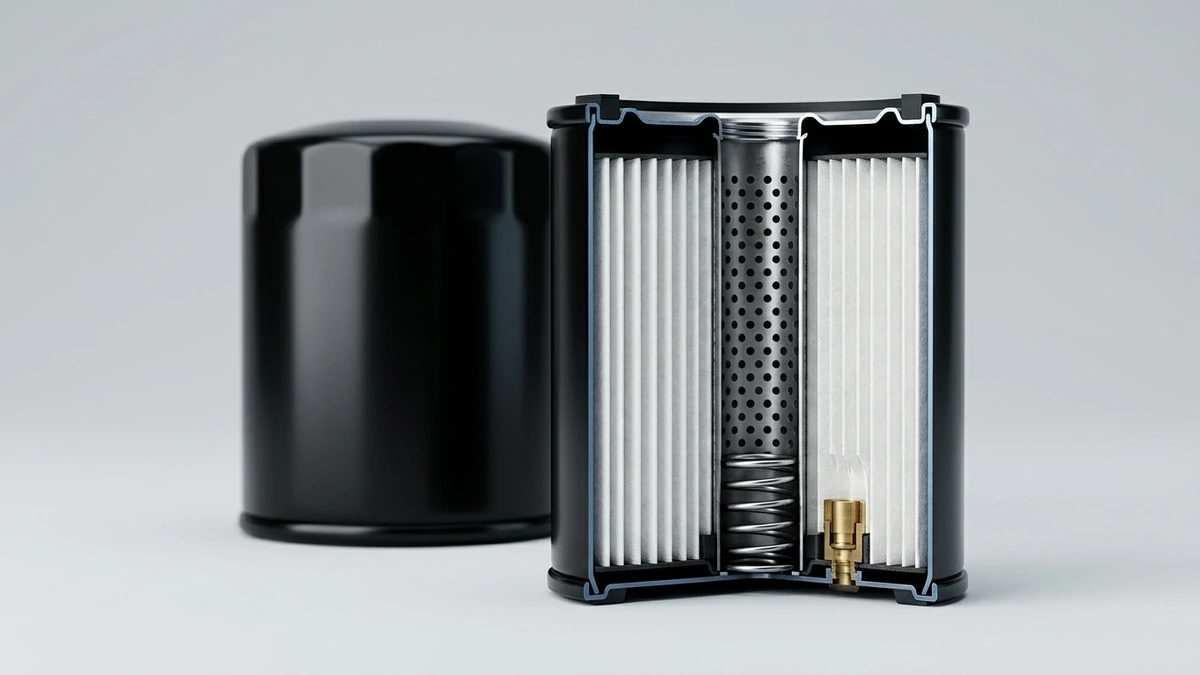
Once that valve lifts, oil reaches the bearings unfiltered. The filter has not failed safe so much as failed open. The same bulletin lists “improper oil drain and filter change intervals” among the causes of collapsed centre tubes, and is direct about where that ends: a malfunctioning bypass valve can produce “a catastrophic failure of the engine… due to the seizure of a piston, connecting rod, or main crankshaft bearings.”
This is also where filter build quality stops being an abstraction. The centre tube, the media adhesive and the bypass valve are what hold up at 25 psi differential on a cold start. Our oil filters are tested to ISO 4548-12, the multipass method that measures filtration efficiency and contaminant capacity rather than simply confirming the part fits.
Let oil analysis set the interval
Every fixed number on this page is a fallback. Caterpillar's own framing is that “scheduled oil sampling analyzes used oil in order to determine if the oil change interval is suitable for your specific engine” — the 250/500/1,000-hour table applies only when you are not sampling.
A used-oil programme tracks wear metals, soot loading, viscosity change, fuel dilution, coolant ingress and oxidation, typically by methods such as ASTM D6595 for wear metals and ASTM D7899 for soot. Deliberately, we are not publishing threshold values here: the condemning limits are specific to the engine, the oil and the laboratory, and no engine maker publishes a universal set. Your lab supplies the limits along with the results. What the tables above give you is the starting interval to sample against.
Frequently asked questions
How often should you change a diesel engine oil filter?
It depends on duty cycle. Cummins: 25,000–75,000 miles for the X15 by fuel-economy band. Caterpillar: 250, 500 or 1,000 service hours by sump size, or annually for standby. Read the number from your engine's manual and use the tables above to check it is plausible.
Does synthetic oil let you extend the interval?
Not per Cummins Bulletin 5410641, which states that synthetic and semi-synthetic oils do not extend oil drain intervals. Extended-drain filter hardware does.
What happens if you leave the filter on too long?
The bypass valve opens at somewhere between 4 and 75 psid depending on the engine, and unfiltered oil circulates until the next change. Sustained bypass operation is associated with collapsed centre tubes and, in the FMC's wording, possible seizure of a piston, connecting rod or main bearing.
Hours or miles?
Whichever comes first. Idle time accumulates hours without accumulating miles, which is why Cummins pairs mileage bands with a 500-hour vocational ceiling.
Does over-tightening the filter affect this?
It affects whether the filter survives the interval at all. Over-torquing distorts the sealing gasket and is a common cause of leaks and element damage — see how tight an oil filter should be.
Buying filters for a mixed fleet? Kaltreo supplies OE-equivalent oil filters cross-referenced to Cummins, Caterpillar, Fleetguard, Donaldson and Baldwin part numbers. Check the cross-reference tables or request a quote.
Sources: Cummins Bulletin 5410641 (X15, EPA 2017), rev. 11/17 · Cummins Bulletin 6504123 (2021 X15 Performance Hardware), rev. 6/25 · Caterpillar SEBU7148-09, Operation & Maintenance Manual, 3508B/3512B/3516B Generator Sets, October 2009 · Filter Manufacturers Council TSB 88-3R2, Diagnosing Engine Oil Filters With Collapsed Center Tubes · ISO 4548-12:2017. Intervals are quoted for the engine families named and are not transferable to other engines.