 Kaltreo Power
Service guide · Published August 2026 · Updated September 2026
How to Clean an Intercooler (Charge Air Cooler)
Quick answer: Pressure-test the cooler first. Navistar specifies 30 psi (205 kPa) held for 15 seconds; a drop of more than 5 psi means replace it, not clean it. If it passes, flush it with the engine maker's specified cleaner, rinse until no cleaning agent remains, dry it fully with compressed air, and refit. Then find what put the mess there — a fouled cooler is a symptom, not a maintenance item.
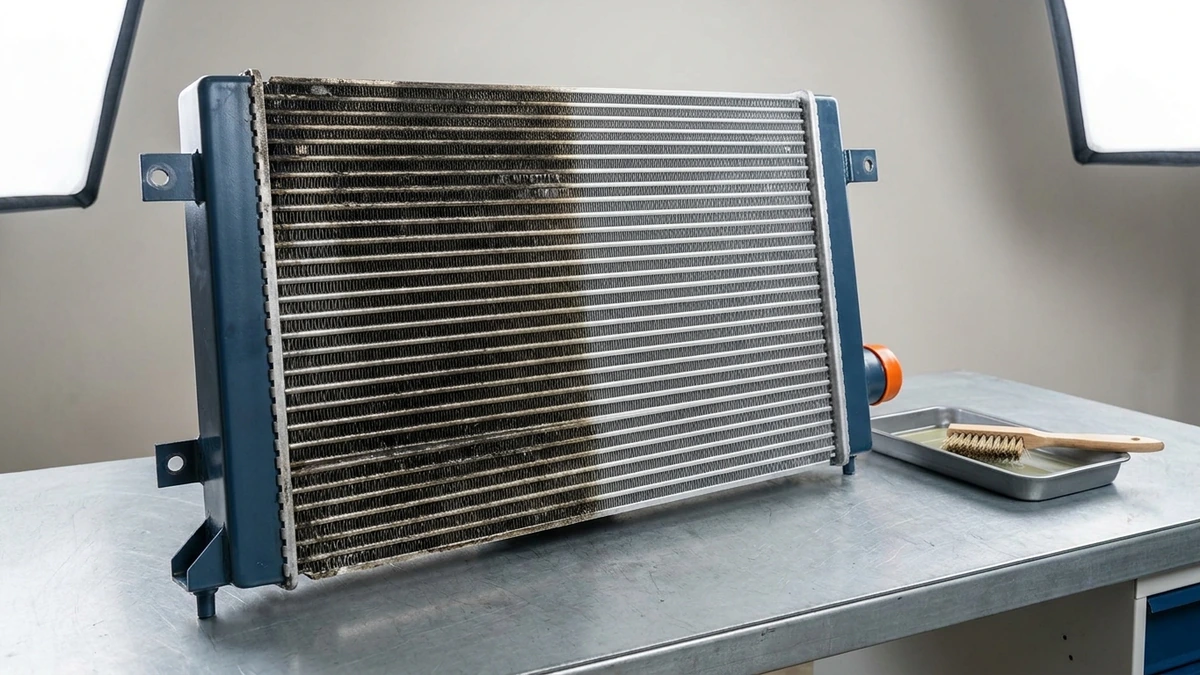
Test before you clean
Most guides open with the flush. The OEM procedures don't. Navistar's IK1201175 tests the cooler first and only cleans one that passes:
| Step | Navistar specification |
|---|---|
| Test pressure | 30 psi (205 kPa), regulated to 28–32 psi |
| Hold time | 15 seconds, repeated three times |
| Fail | Drop over 5 psi (34 kPa) → replace the cooler |
| Pass | Drop of 5 psi or less → proceed to clean |
Do not submerge it. Navistar is explicit: “CACs are not required to be leak proof. Do NOT test CAC for leakage by submerging it in a radiator test tank. Almost all CACs will show leakage if they are submerged.” Submersion is a method for liquid-cooled cores. Applied to an air-to-air cooler it condemns good parts.
Read what drains out
Drain into a clean pan before cleaning anything. What comes out names the system that failed, and each answer points at a different part.
| What drains out | Likely source | Check first |
|---|---|---|
| Thin oil film | Normal blow-by carry-over | Nothing — expected |
| Pooled oil | Crankcase ventilation pushing oil mist into the intake | Breather / CCV element, crankcase pressure |
| Dry dust or sand | Unfiltered air: damaged element, bad seal, leaking intake pipe | Air element and every joint to the turbo |
| Oily mud | Both at once — abrasive grit with a binder holding it to the walls | Air and breather filtration, plus service intervals |
| Coolant or a sweet smell | Internal leak in a liquid-cooled cooler, or a failed EGR cooler | Stop and pressure-test — do not flush |
| Metallic glitter | Compressor wheel damage from ingested debris | Turbo, then the filtration that let it in |
Two rows carry the weight. Dry dust is a filtration emergency — whatever the cooler caught, the cylinders also saw. And pooled oil is usually a crankcase story, not a turbo story. MAHLE lists excess crankcase back pressure, defective crankcase ventilation and even a clogged air filter among the causes of oil loss from a turbocharger. The breather element costs a fraction of a cartridge. Change it and re-measure crankcase pressure first.
The cleaning procedure
There is no universal recipe, and anyone publishing one is guessing. Engine makers specify their own cleaners at concentrations that differ by an order of magnitude. Navistar flushes with a 50/50 dilution of its own EGR cleaning fluid held at about 130 °F (54 °C), back-flushing for 20 minutes, then forward-flushing for 20. Caterpillar's liquid-cooled procedure uses a far stronger concentration of a different proprietary cleaner. Use what your engine's manual names.
What the sources do agree on:
- Flush both directions, then rinse. Navistar rinses with hot tap water and permits cold, blowing the core dry with compressed air between rinses.
- Rinse until no cleaning agent remains. Caterpillar's warning for cooling systems applies equally here: incomplete rinsing damages metal components.
- Keep cleaning pressures low. Caterpillar caps air at the nozzle below 205 kPa (30 psi) and water below 275 kPa (40 psi), directed parallel to the fins, nozzle about 6 mm away (SEBU8407-06). Off-angle pressure bends fins.
- Dry it completely before refitting. Residual liquid goes to the cylinders on the next start.
For external fouling — the air side, not the bore — Caterpillar's guidance is simply to use the same methods as for a radiator, with a degreaser and steam for oil and grease, then inspect the core against a light bulb and repeat if needed.
When to replace instead
The sources genuinely disagree here, and the distinction is worth knowing. Caterpillar and Navistar both publish procedures meant to return a cooler to service. MAHLE, writing specifically about turbocharger failure, says the charge air line should be cleaned and the charge air cooler replaced.
Both are right in their own context. After a failed turbo, the cooler holds oil that will be ingested by the replacement on first start — cleaning is a gamble against a new turbocharger. For fouling without a turbo failure, the OEM flush is the intended repair. Add the leak test above: a cooler that fails it was never a cleaning candidate.
Stop it coming back
Cleaning without fixing the cause books the same job next quarter. Caterpillar is direct about the mechanism in its 3600 series installation guide: air cleaners are 99.5% efficient “for proper turbocharger and aftercooler performance”, and “use of less efficient elements will result in turbocharger compressor wheel and aftercooler fouling.” Cheap elements foul coolers. That is the causal chain, stated by the engine maker.
The same document gives the numbers the internet usually gets wrong. Maximum allowable inlet restriction on that engine family is 3.7 kPa (15 in H₂O) with dirty elements and 1.2 kPa (5 in H₂O) clean — not the 25 in H₂O widely repeated online. Donaldson publishes no figure at all and simply says not to exceed the engine maker's limit, so take yours from your own engine's data sheet. Fit a restriction indicator and the question becomes a reading rather than a guess — our filter replacement schedule covers how duty and conditions move air filter service.
Frequently asked questions
How do you clean an intercooler?
Pressure-test first: 30 psi for 15 seconds, more than a 5 psi drop means replace. If it passes, flush with the engine maker's specified cleaner in both directions, rinse until no cleaning agent remains, dry fully with compressed air, refit.
Should you submerge it to find leaks?
Not an air-to-air cooler. Navistar states CACs are not required to be leak proof and almost all will show leakage if submerged. Use pressure decay instead.
Why is there oil in my intercooler?
A light film is normal. Pooled oil usually means crankcase ventilation, not the turbo — MAHLE lists crankcase back pressure, defective ventilation and even a clogged air filter among the causes. Check the breather first.
Can you clean it without removing it?
Not properly. Aerosol cleaners cannot be drained, rinsed or pressure-tested, so residue reaches the cylinders on the next start.
How often should it be cleaned?
On condition. When intake manifold temperature rises at the same load and ambient, when pressure drop exceeds the engine maker's limit, or when the cooler is already off for other work.
Most fouled coolers trace back to air or crankcase filtration. Kaltreo supplies OE-equivalent air and crankcase breather filters, oil and fuel filters, kittable per engine platform and cross-referenced to all major brands. Check the cross-reference tables or request a quote →
Sources: Navistar IK1201175, Charge Air Cooler Cleaning Procedure for I-6 Engines, rev. 0, Aug 2014 · Caterpillar SEBU8407-06, Operation & Maintenance Manual, Feb 2012 · Caterpillar SEBU7148-09, Operation & Maintenance Manual, Oct 2009 · Caterpillar LEKM8466, 3600 Marine Engine Application and Installation Guide, 8-98 · MAHLE MPULSE, Why does a turbocharger lose oil?, updated Mar 2022 · Donaldson, Servicing Your Air Filter. Figures are quoted for the engine families named and are not transferable — always follow your own engine manual. Some OEM documents are cited by document number and served from third-party hosts.